
Affectionately called “DocStars,” The Cary Council’s Early-Stage Research Grant recipients are leading medical progress forward. Since its founding in 2015, The Cary Council has awarded 24 Early-Stage Research Grants worth $1.2 million. To date, that initial investment has garnered more than $30 million in follow-on funding. Prasanna Alluri, M.D., Ph.D., received the Early-Stage Research Grant from The Cary Council in 2018 for his project building targeted therapies to overcome treatment-resistant breast cancer.
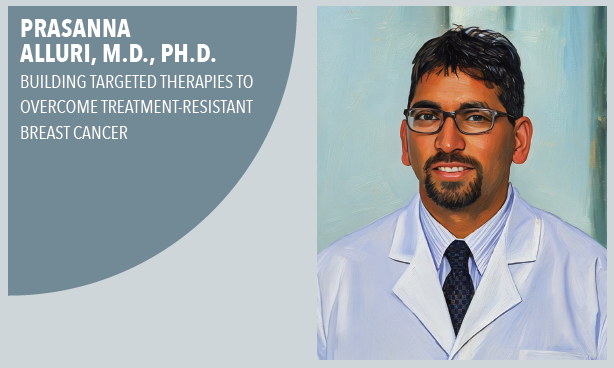
2025 Update from Prasanna Alluri, M.D., Ph.D.
Prasanna Alluri, M.D., Ph.D., is a physician-scientist and Assistant Professor of Radiation Oncology at UT Southwestern Medical Center, where he is committed to improving the care of breast cancer patients. His research focuses on the development of new approaches to overcome treatment resistance in patients with aggressive forms of breast cancer. In 2018, he was awarded an Early-Stage Research Grant by The Cary Council to support his promising research. Since then, Dr. Alluri and his team received multiple additional awards totaling nearly $11 million, including grants from private foundations, the state of Texas, and federal sources like the Department of Defense and the National Institutes of Health.
One of the most difficult aspects of being an early-career researcher is securing initial funding, as most granting institutions require a proven track record. However, as Dr. Alluri notes, The Cary Council’s focus on early-career investigators is critical to the development of groundbreaking research. While he acknowledges that it may be riskier to invest in newcomers, it’s important to note that new investigators are often those who bring fresh ideas and perspectives. Dr. Alluri recognizes that The Cary Council’s early investment in his research allowed him to take bigger risks that likely would not have been possible in the traditional funding structure seen within medicine. Those risks, he notes, were instrumental in every developmental aspect of Alluri Laboratory, and even now, eight years later, continue to impact its structure and focus. “I would say this was a substantial reason for the successes we have had since starting my lab,” explains Dr. Alluri.
Based on highly promising laboratory data, current efforts in Dr. Alluri’s lab are focused on the development of a clinical trial that aims to stimulate the patient’s immune system to eradicate aggressive forms of breast cancer that do not respond to existing treatments. As he says, “I couldn’t be more excited to see where this takes us in terms of improving patient care.” Supported by a $2.5 million Breakthrough Award from the Department of Defense, Dr. Alluri’s lab is working to create a therapeutic cancer vaccine that puts breast cancer into long-term remission. Traditionally, to be effective, breast cancer immunotherapies must be combined with chemotherapy, a course of treatment that is both long and toxic for patients. Promisingly, Dr. Alluri’s team has developed a much shorter treatment course–one that required less than a week when tested on mice.
For Dr. Alluri and other DocStars, support from The Cary Council extends beyond funding. Dr. Alluri highlights how Council members’ experience in business, startups, and investments is a valuable resource for researchers, whose own expertise lies within the lab and clinic. “If any of this requires a startup to advance a new treatment,” said Dr. Alluri, “I think they have the potential to make a difference, especially in an area that we have very little expertise in.”
Such experience on the part of Council members is invaluable as researchers look to create impact beyond the lab.
Meet All of the DocStars
Learn more about all of the researchers who have been awarded The Cary Council’s Early-Stage Research Grant.