Smart Giving Strategies for 2026 and Beyond
When the winds change, skilled navigators adjust their sails—not their destination.
If one of your philanthropic goals is to support UT Southwestern Medical Center or Southwestern Medical Foundation, you may be wondering how the changes introduced by the One Big Beautiful Bill Act (OBBBA) could affect the way you plan, save, and give. While some rules have changed considerably, you can still chart a course toward impacting our shared mission to build a better, healthier world.
In this issue of Planning Matters, we will walk you through important OBBBA updates related to charitable giving and estate planning and share simple strategies to help you make the most of your thoughtful giving. We also invite you to read Marion Flores’ story about her enduring commitment to UT Southwestern through her planned gift and membership in The Wildenthal Society.
Our complimentary booklet, Gifts of Stock, explores how donating appreciated stock can help maximize charitable giving while reducing taxes. We welcome the opportunity to discuss with you the advantages of giving stock or other ways of giving that address your personal, financial, and charitable goals.
Thank you for your continued generosity. Together, we can turn purposeful planning into a lasting legacy that supports groundbreaking research, exceptional patient care, and innovative medical education.

Sincerely,
Randal Daugherty, CAP
Director of Development, Gift Planning
UT Southwestern Medical Center
Adapting to Change. Maximizing Impact.
The OBBBA introduced changes that may affect how and when you give, as well as the financial benefits of your generosity. Understanding the rules helps you plan to maximize both your impact and your tax savings. Here are the key updates for potential and current donors:
- Continued higher deduction limit for cash gifts. The 60%-of-AGI limit is now permanent.
- Higher standard deduction. In 2026, the standard deduction is $16,100 for single filers and $32,200 for married couples filing jointly. This continued high deduction means fewer people may itemize deductions.
- New “giving floor” for itemizers. You can only deduct charitable contributions once they exceed 0.5% of your adjusted gross income (AGI). For example, if your AGI is $300,000, only gift amounts over $1,500 are eligible for a deduction.
- New cap on deductions for high earners. If you’re in the top 37% tax bracket, the tax benefit for your charitable deductions is limited to 35%.
- New deduction for non-itemizers. Even if you don’t itemize, you can now deduct up to $1,000 ($2,000 for joint filers) for cash gifts to qualified charities like UT Southwestern or Southwestern Medical Foundation. This new opportunity can make even modest gifts more rewarding, so keep track of your cash donations.
- Continued deduction for seniors. If you are age 65 or older, you can take an additional $6,000 deduction.

Smart Strategies for This Year and Beyond
Once you know the rules, you can plan to make the most of them. Here are some tax-savvy approaches to consider in light of the new OBBBA provisions.
Give Now, Deduct Now
Cash gifts remain one of the simplest and fastest ways to make a difference, and there are even stronger incentives under the new rules.
Example: Linda, age 60, typically supports UT Southwestern with a $10,000 gift each year. This is a significant gift, but with the standard deduction at $16,100 in 2026, that alone is still not enough to make itemizing worthwhile. Still, Linda would qualify for the $1,000 deduction available to non-itemizers.
After receiving a large bonus, though, Linda decides to increase her annual gift to $40,000 this year to make itemizing worthwhile and provide additional support for our work. Linda’s AGI is $500,000. Because of the new giving floor, she can only deduct any gifts above 0.5% of her AGI—in her case, above $2,500. Therefore, she can deduct $37,500. In her 35% tax bracket, that’s a savings of $13,125.*
Give Assets, Not Cash
While cash is easy, it isn’t always the most tax-efficient way to give. If you will be impacted by the new giving floor or deduction limits, the double tax benefit of giving appreciated stock or real estate that you have held for longer than one year is especially valuable. It allows you to:
- Bypass the capital gains tax that would have been due on a sale of the assets.
- Deduct the full fair market value of the assets (subject to limitations).
The added capital gains tax benefit can more than make up for any limits on the charitable income tax deduction.
Example: Wallace wants to give $5,000 to UT Southwestern this year. He is also considering selling shares of stock valued at $5,000 (originally purchased for $2,000). Wallace decides to donate the stock to us directly. This allows him to avoid paying the capital gains tax on the $3,000 appreciation—a savings of $450 in his 15% capital gains tax bracket. If he meets the 0.5%-of-AGI giving floor, he can also take a deduction for the full $5,000 (subject to limitations).*
Give from Your IRA
If you are an IRA owner age 70½ or older, a qualified charitable distribution (QCD) from your IRA is one of the most practical and tax-wise ways to give, whether you itemize or not. Because it reduces your taxable income directly, this option is unaffected by the new limitations on deductions.
By transferring funds directly from your IRA to UT Southwestern, you can:
- Pay no income tax on the distribution (up to $111,000 in 2026).
- Satisfy all or part of your required minimum distribution (RMD) if one is due.
Example: Marie, age 78, is required to take a $10,000 taxable distribution from her IRA this year. Instead, she uses a QCD to distribute $10,000 from her IRA to Southwestern Medical Foundation to benefit UT Southwestern. She pays no income tax on the $10,000 transfer and satisfies her RMD.*
A one-time option allows you to use up to $55,000 (in 2026) from your IRA to establish a new charitable gift annuity (CGA) or charitable remainder trust (CRT)—giving tools that also provide a lifetime income for you and/or your spouse. Spouses can combine distributions from their own IRAs to create a joint-life CGA or a single CRT. This distribution is also tax free and counts toward your RMD.
Give for Multiple Years in One Tax Year
Bunching gifts simply means making larger, less frequent gifts to secure a more powerful tax advantage. For example, you might give two years’ worth of gifts to UT Southwestern this year, then skip your usual donation next year. This can help ensure that you surpass the standard deduction (making itemizing worthwhile). It can also help minimize the impact of the new giving floor.
Give for the Future
One way to avoid the new limitations on charitable deductions is to add UT Southwestern or Southwestern Medical Foundation to your will or living trust or name us as the beneficiary of a donor-advised fund, life insurance policy, or retirement account. These legacy gifts reflect your values, strengthen our mission, and demonstrate lasting support for pioneering research, providing exceptional patient care, and access to high-level education and training opportunities. A future gift also has no impact on your current finances and is easy to change if your needs or goals change.
*All examples are for illustrative purposes only.

The Wildenthal Society Spotlight
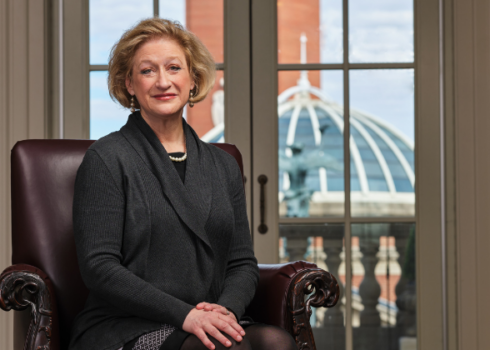
“When I think about what UT Southwestern was in the 1980s compared to today, the difference is amazing. I felt it in the lectures we attended—the science was cutting-edge, the speakers were exceptional, and the presentations were delivered with clarity and quality.”
-Marion T. Flores
Member, The Wildenthal Society
Help Us Grow Our Wildenthal Society and Inspire Others
Informing us of your bequest intentions allows us to ensure your gift is promptly received and properly used. By sharing what you hope to accomplish, we can help structure your gift to reflect your intended impact.
A growing Wildenthal Society sends a clear message that there is a community of supporters who wish to leave a legacy of giving that will help UT Southwestern remain a leader in research, patient care, and medical education. Your commitment will be an example for others like you to consider their own estate plan.
If you have provided for UT Southwestern through a planned gift, please contact us so we can understand your wishes and ensure that your gift can be used as you have intended.
To inform us of your bequest intentions or discuss your interest in doing so, please contact UT Southwestern’s Gift Planning Office by calling Randal Daugherty at 214.648.3069 or Randal.Daugherty@utsouthwestern.edu or Diana Kao at 469.852.8541 or Diana.Kao@utsouthwestern.edu.
A Legacy That Endures
Generosity like yours is a steady beacon that lights the way for others. Rules may evolve, but the values behind your giving—care, compassion, community—endure. Let us help you and your advisors explore thoughtful ways to carry those values forward. Reach out or use the form linked below to request more information or a complimentary copy of our booklet, Gifts of Stock. Together, we can plan for your lasting legacy.