
Key takeaways:
- Philanthropy enables faster, more agile responses to institutional needs.
- Authentic leadership occurs when your words align with your actions.
- Presence matters: only 7% of communication is words, and 93% is how you convey the message.
- Multiple perspectives improve decisions and fuel innovation.
- TWU is expanding into a major university system while maintaining its mission as a women-centered institution.
Who Is Carine Feyten, Ph.D.? (TWU Chancellor)
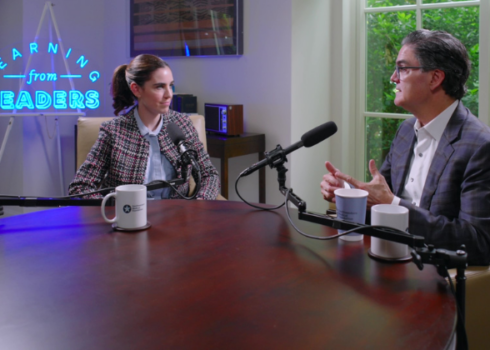
Carine Feyten, Ph.D., is Chancellor of the Texas Woman’s University System and President of Texas Woman’s University in Denton. Prior to joining TWU in 2014, Dr. Feyten spent 13 years at the University of South Florida, where she was a professor of Secondary Education, chair of the Department of Secondary Education, and director of the Foreign Language Education Program, among other roles. Following her time in Tampa, Dr. Feyten served as the dean of the College of Education, Health and Society at Miami University of Ohio. Recently, Dr. Feyten joined Lili Clark of the Learning from Leaders podcast to discuss her leadership style, recent milestones for the university, and her hopes for its future.
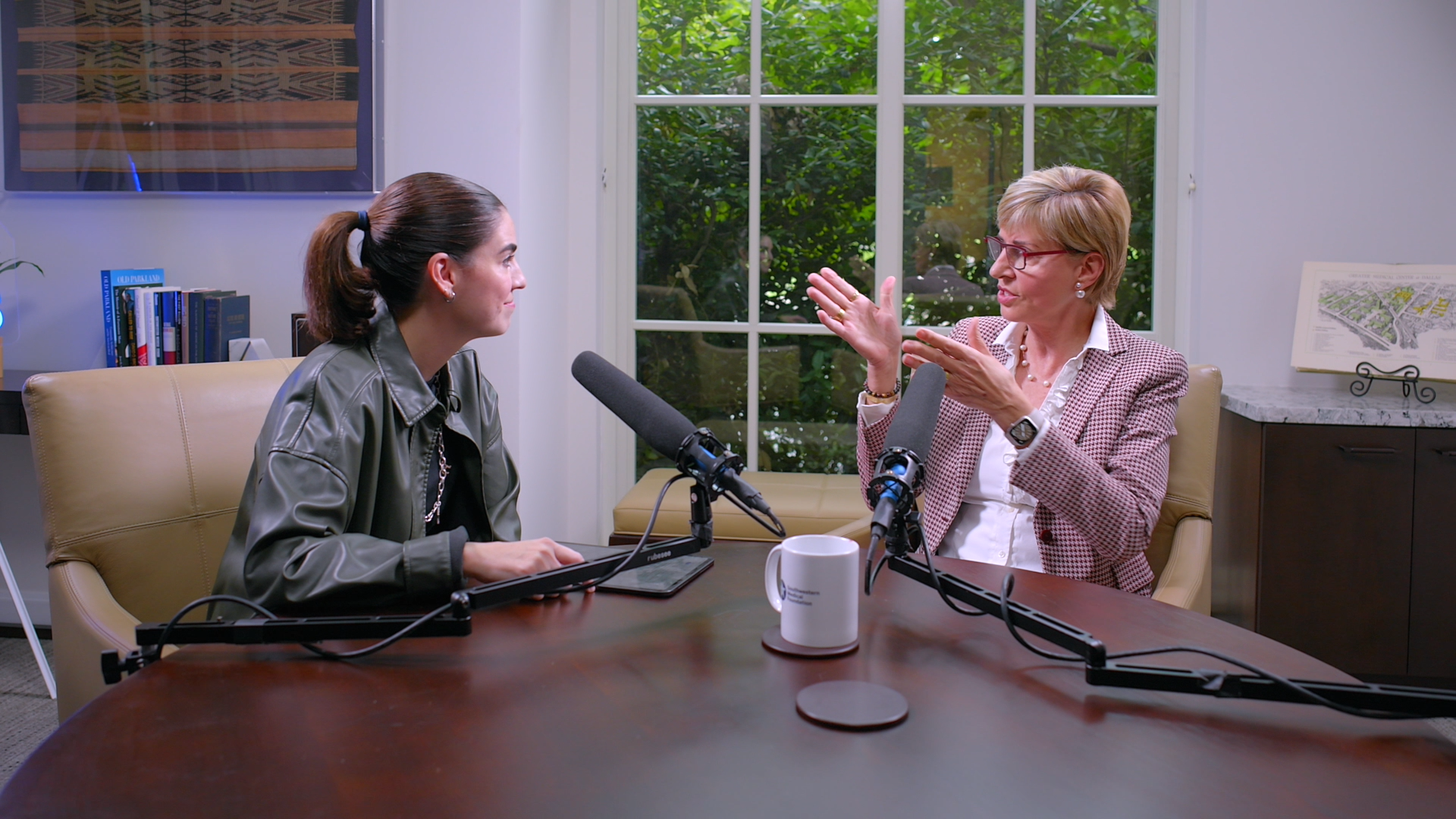
“If I look through that window, I see one slice of the world. If I look through the window behind me, you see a different slice of the world. It’s the same world, but you look at it from a different perspective.”
Carine Feyten, Ph.D.
Language Lessons in Leadership
Dr. Feyten holds a Ph.D. in Interdisciplinary Education with an emphasis on Second Language Acquisition and speaks five living languages and two dead ones. As she describes, her language training helped her “realize the importance of multiple perspectives.” To her, each language is “a different window on the world.” She continues: “if I look through that window, I see one slice of the world. If I look through the window behind me, you see a different slice of the world. It’s the same world, but you look at it from a different perspective.” This view is central to Dr. Feyten’s style of leadership. “Until you have all the different perspectives,” she asserts, “you really don’t have a complete picture on how to tackle an issue, how to make decisions, how to pursue anything.” Bringing different viewpoints to the table fuels innovation, creativity, and solutions to “problems that in the past seemed to be intractable.”
Listen to the Podcast
An Interdisciplinary Approach
At TWU, this emphasis on different perspectives is evident in the classroom and beyond. Already a leader in nursing, in 2023 the university began building a new Health Sciences Center in Denton. The Center is designed to foster interdisciplinary collaboration, bringing students in nursing, occupational therapy, nutrition, and physical therapy into the same classrooms and labs, which is especially significant given that half of the student body is enrolled in a health sciences major. As Dr. Feyten acknowledges, “Everybody understands that in order to have good holistic care, you need to look at things from multiple perspectives.” Because of TWU’s educational model, students “will be prepared … when they enter the workforce, to really work in teams to help their patients.”
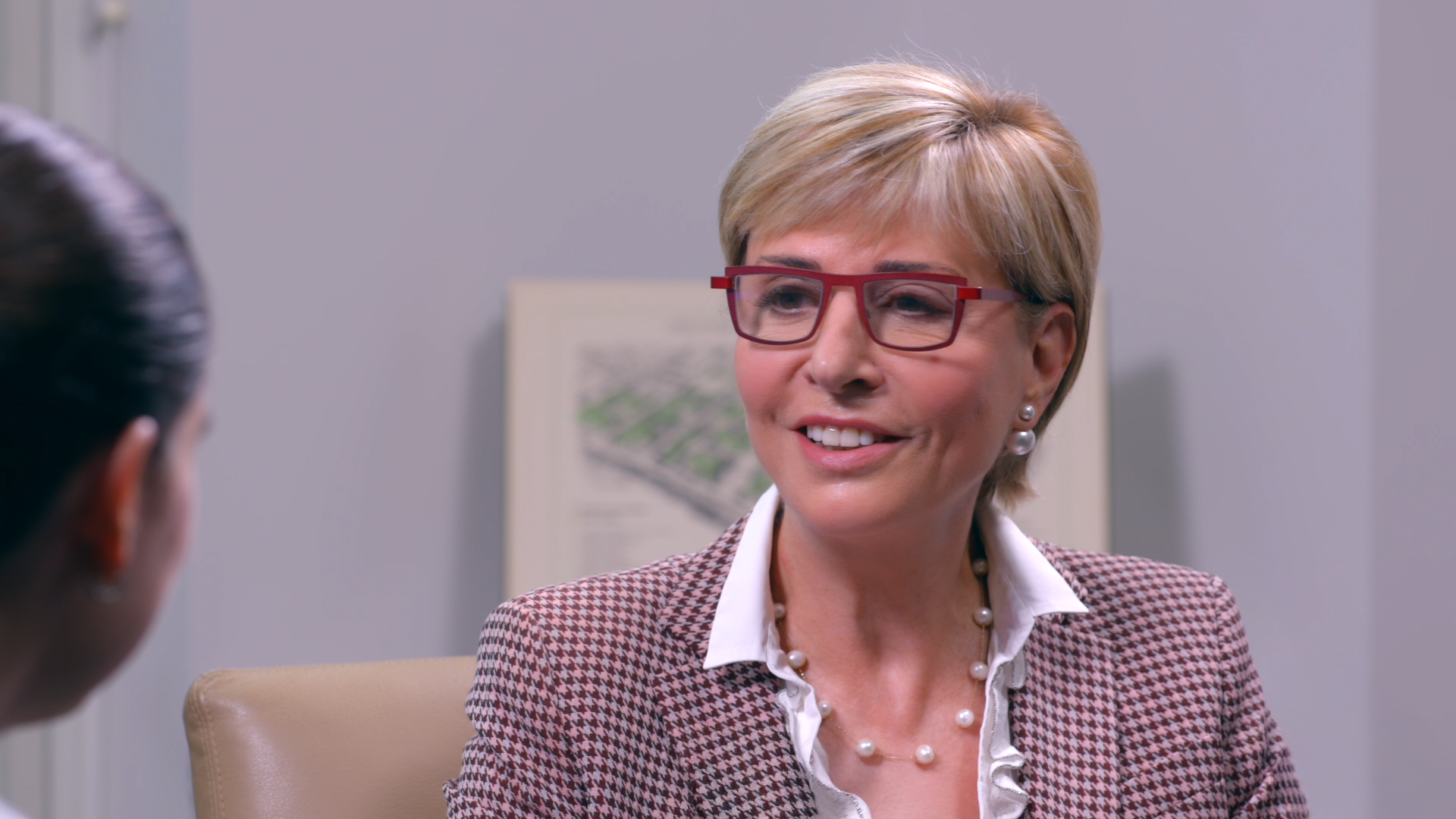
“Philanthropy allows you to immediately respond and act”
Carine Feyten, Ph.D.
Adapting to Change and Looking Toward the Future
In 2026, TWU will be celebrating a milestone anniversary. Founded in 1901 to educate women, the university has broadened its mission in the 125 years since to include other groups underrepresented in higher education, including veterans, former foster care youth, women with children, low-income students, and first-generation students. Today, 90% of TWU’s students are female, and under Dr. Feyten’s leadership, the university “decided to really lean into … our identity.” This branding has also attracted philanthropy: As Dr. Feyten notes, leaning into what makes TWU different from other universities “opened all the doors for people who want to support those causes.” The new School of Aeronautical Sciences, which was created to respond to the pilot shortage and address the pilot gender gap, was made possible in large part because of a $15 million gift from the Doswell Foundation. Further, BuzzBallz founder and TWU alumna Merrilee Kick gave $30 million to the College of Business and Entrepreneurship. As Dr. Feyten highlights, “Philanthropy allows you to immediately respond and act” with agility, which is not always possible when relying on state funding alone.
Another significant step TWU took under Dr. Feyten’s leadership was becoming a university system in 2021. After stepping into the president role at TWU in 2014, Dr. Feyten noticed the changing landscape of Texas higher education, and realized TWU needed to “become a system if we wanted to continue to keep our mission.” Importantly, TWU is the only university system in the country with a women-focused mission. Becoming a system has allowed the university “an opportunity to scale, but without losing the soul, so to speak, of TWU,” as Dr. Feyten says, and helped the university put greater emphasis on its programs in Houston and Dallas. Moving forward, Dr. Feyten is committed to continuing to expand opportunities for women in Texas. Through initiatives including the Merrilee Alexander Kick College of Business and Entrepreneurship, Dr. Feyten hopes to help Texas become the nation’s leader in women-owned business. As she concludes, “One of my big dreams” is “giving more opportunities to women to step into high-paying jobs.”
Leading with Authenticity
When it comes to mentorship, Dr. Feyten explains that she thinks of it “a little bit differently” than most people. Rather than look to a mentor as a person to emulate in all areas, Dr. Feyten notices specific strengths people have and seeks to learn from them. She cites a conference she once attended where the president of an organization gave a talk. Despite not remembering the topic or the name of the speaker, Dr. Feyten recalls her poise, presence, and eloquence–and thinking “wow, I want to be just like that one day.” To Dr. Feyten, this experience illustrates an importance point about communication, which is that, according to research, “only 7% of your message is communicated through words,” meaning “93% of your message is how you show up.” This lesson is one that has resonated with Dr. Feyten throughout her career. As Dr. Feyten says, “It’s your presence [that is] … going to make a difference in terms of whether [people] receive [your] message, whether you’re teaching in a classroom or you’re leading an institution.” She continues: “It’s [about] … bringing people … on board, and they have to be able to trust and feel like [your message] is authentic.”