

By: Cullum Clark, Ph.D.
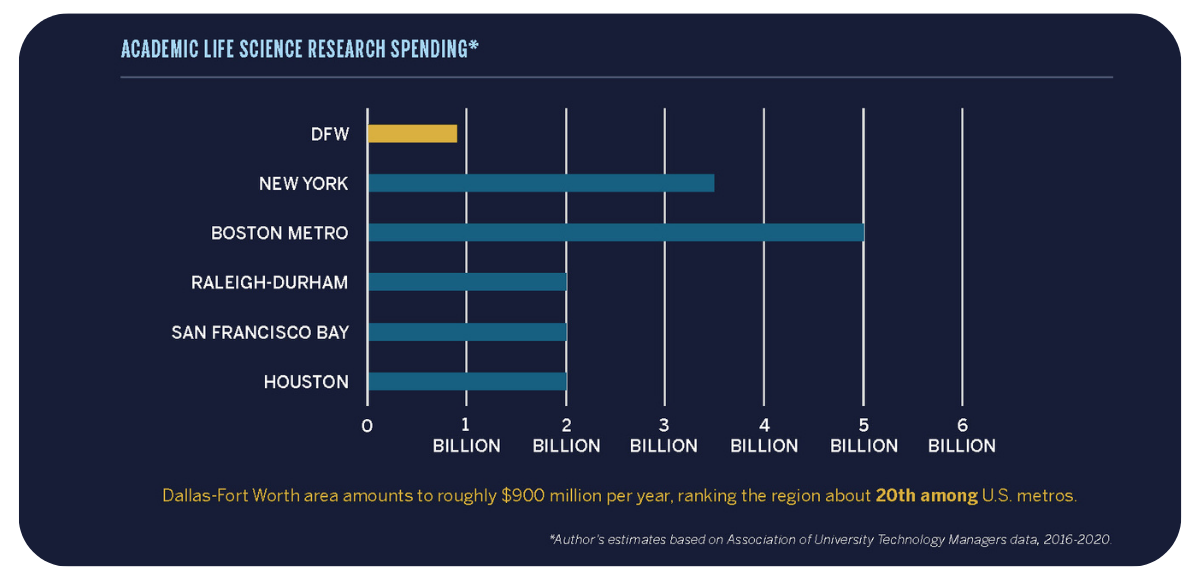
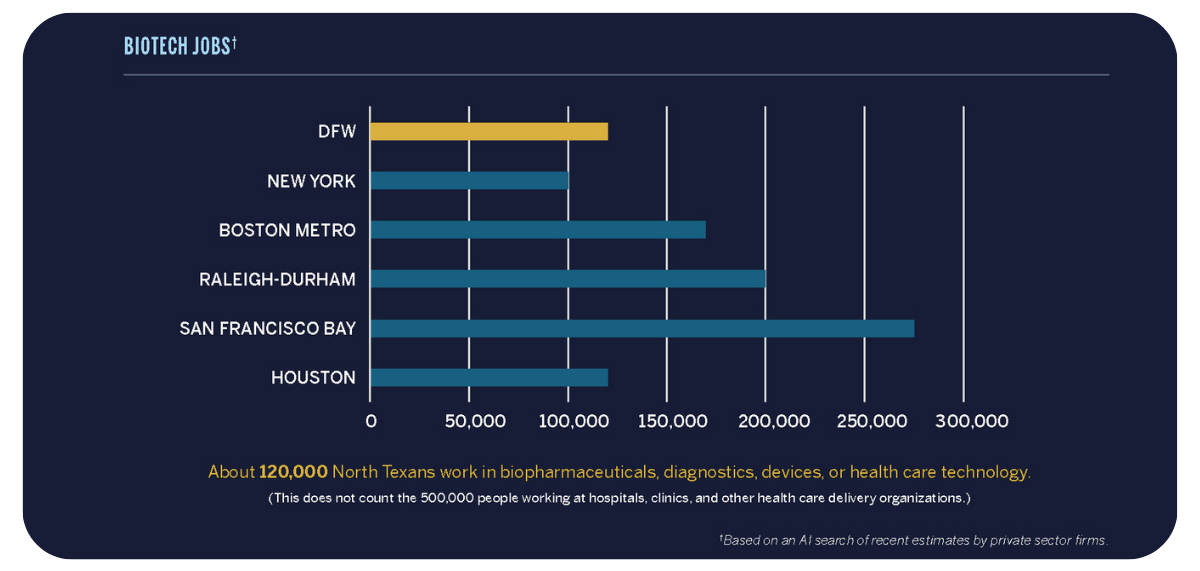
Texas started out a latecomer in the fiercely competitive pharmaceutical and medical technology industries. Most of today’s leading health care firms were founded before World War II, primarily in the Northeast and Northern Europe. But for the past four decades, Dallas-Fort Worth and other Texas metros have played an aggressive game of catch-up. Since the mid-1980s the DFW life sciences industry has seen tremendous growth in outstanding researchers, entrepreneurs, investors, philanthropists, and companies. The region’s life sciences growth translates not only into economic growth but also to better outcomes for patients and their families.
Origins in the 1980s
Dallas’ biotech story began with Mayor Starke Taylor’s appointment of a “Biotechnology Task Force” in 1984. Taylor’s initiative was born from adversity. The region’s economy was reeling from collapsing oil prices and disarray in banking and real estate. Meanwhile, UT Southwestern Medical Center – then known as the University of Texas Health Science Center at Dallas (UTHSCD) – faced drastic budget cuts from the Texas Legislature, also pinched by falling oil revenues. UT Southwestern was a much smaller institution then, but the prospect of financial distress still touched a sensitive nerve among civic leaders.
Taylor, a cotton trading entrepreneur, and other business leaders concluded that Dallas needed bold moves to strengthen its medical establishment and diversify its economy. A key part of the answer was biotech.
The task force’s chairman was Vin Prothro, a Texas Instruments veteran and co-founder of two Dallas-area semiconductor companies. It included other Dallasites who would later feature among UT Southwestern’s premier benefactors – Mary McDermott Cook, Robert Decherd, Ted Enloe, Richard Fisher, Ray Hunt, Peter O’Donnell Jr., and William T. Solomon – as well as UT Southwestern leaders Kern Wildenthal, M.D., Ph.D., William Neaves, Ph.D., Philip Montgomery, and researchers Michael Brown, M.D., and Joseph Goldstein, M.D.
The task force’s 1985 report highlighted a stark disconnect: UT Southwestern was “one of the most outstanding biomedical research institutions in the country,” but neither the university nor the region were positioned to translate world-class research into useful medical products or build firms that could take them to market.


Dallas’ medical school – then the only one in North Texas – had come a long way since its founding in 1943. Longtime UT Southwestern faculty give considerable credit to Donald Seldin, M.D., who arrived in 1951 when the institution was still operating out of temporary plywood buildings constructed with Army assistance during WWII and later nicknamed “The Shacks.” Dr. Seldin patiently built the university’s faculty and culture over a legendary 67-year career, including 36 years as chairman of the Department of Medicine. By 1985, the task force could cite Harvard researchers who ranked UT Southwestern among America’s top half dozen academic medical centers.
But Dallas suffered from a shortage of financial capital aimed at commercializing local research. The university lacked basic business skills and networks, and The University of Texas System rules prevented it from creating beneficial incentives by not allowing researchers to own stock in companies that commercialized their work. The task force contrasted Dallas with the Northeast and West Coast, where leading-edge companies Genentech, Biogen, and Amgen came into being between 1976 and 1980 through close collaboration with the Stanford and Harvard medical centers.
The task force called for establishing a for-profit commercialization entity focused on UT Southwestern research, streamlining patent and license processes, and improving researchers’ incentive structures.
Their report led to the launch of Dallas Biomedical Corporation, the region’s first for-profit biotech enterprise, in March 1986. Dallas Biomedical raised $12.4 million ($39 million in 2026 dollars) from Dallas financial institutions and investors, oil company Diamond Shamrock, and venture capital firms New Enterprise Associates and its Texas affiliate, Southwest Enterprise Associates, then headed by Prothro.
Dallas Biomedical promised investors a conservative financial model: It would invest only the interest on its $12.4 million capital base in biotech commercialization, which meant it could invest only about $3 million over its five-year life. The firm would in-license UT Southwestern technologies in return for a 50 percent interest in any profits, fund early-stage product development, and out-license resulting products to startups or existing firms. The university would invest a matching $3 million in targeted technologies, funded by a grant from the John A. Hartford Foundation, established by the founder of the A&P Food Store chain.
Prothro, who also played a key role in persuading the John D. and Catherine T. MacArthur Foundation to give the university 30 acres that became UT Southwestern’s North Campus, served as board chair. Dallas Biomedical recruited Devon Giacalone, Biogen’s director of commercial operations, as CEO.
Giacalone quickly adjusted Dallas Biomedical’s strategy, as it became clear the firm would need to take a more hands-on approach and fund fewer technologies than planned. Dallas Biomedical funded 30 projects between 1986 and 1990. The initiative produced at least four successful exits, most prominently GeneScreen, which initially focused on genetic markers for diabetes and heart disease but pivoted to commercialize paternity and forensic testing products, ultimately becoming part of the diagnostics giant LabCorp.
Dallas Biomedical returned several million dollars in profits to its investors. More importantly, it demonstrated proof-of-concept: Dallas could create successful biotech companies based on local research.
Worldwide Recognition for UT Southwestern
The 1980s also saw a massive expansion of UT Southwestern’s research prowess and reputation. In October 1985, the same month as Dallas Biomedical’s creation, the Nobel Prize committee awarded the world’s most prestigious medical research prize to Michael Brown, M.D., and Joseph Goldstein, M.D., for their pathbreaking research on how cells metabolize cholesterol. Their work laid the foundation for statin drugs, which reached $37 billion in worldwide revenues two decades following Merck’s launch of Mevacor, the first statin, in 1987. Today, statins remain a cornerstone of cardiovascular disease prevention.
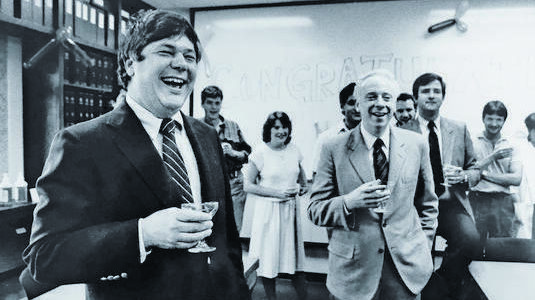
While cholesterol drugs were commercialized by established companies based elsewhere rather than a homegrown Dallas firm, the Brown-Goldstein lab’s work contributed immeasurably to UT Southwestern’s rise. It made the university a global leader in cardiovascular disease, attracted numerous top-tier researchers, and sparked the first of many large philanthropic contributions from Dallas business leader H. Ross Perot and his family.
Four additional researchers who went on to win Nobel Prizes joined the faculty in the 1980s: Johann Deisenhofer, Ph.D., who won the 1988 prize for his work on the three-dimensional shape of key proteins; Alfred Gilman, M.D., Ph.D., the 1994 Nobel awardee for his work on G-protein-coupled receptors, the basis for numerous cardiovascular drugs; Bruce Beutler, M.D., who won the 2011 prize and helped create Amgen’s blockbuster anti-inflammatory drug Enbrel; and Thomas Südhof, M.D., Ph.D., who won the 2013 Nobel for his work on neurotransmitter signals and helped found two brain-focused biotech firms.
Pioneering Companies and Research
Two companies associated with UT Southwestern became significant success stories in the 1990s. First, San Antonio-based Mission Pharmacal commercialized Citracal, a slow-release form of calcium citrate and sodium fluoride for bone strength developed by investigator Charles Pak, M.D. Citracal royalties became UT Southwestern’s largest source of licensing revenues for much of the 1990s and 2000s. Bayer HealthCare bought the rights to Citracal in 2007, and the product remains the most successful extended-release calcium supplement on the market.
Second, in 1995, UT Southwestern recruited biochemist Steven McKnight, Ph.D., co-founder of California-based biotech firm Tularik, and established a large lab that continued to work closely with the company. Amgen acquired Tularik in 2004. While none of Tularik’s early projects made it to market, the acquisition turned Amgen – previously a specialist in biologic drugs like Enbrel – into a top-tier small molecule biopharmaceutical enterprise.
UT Southwestern also continued to expand its science footprint in the 1990s. The university was one of 12 U.S. institutions invited to participate in the historic 1990-2000 Human Genome Project, which gave rise to countless 21st century medical breakthroughs.
In 1999, UT Southwestern established its Office of Technology Development, implementing the unfinished business of the Mayor’s task force, with nephrologist Dennis Stone, M.D., as its first chief. The university also established a more generous incentive system for researchers than most peer institutions offered at the time, which helped attract more top-level scientists. By the mid-2000s, licensing deals were yielding as much as $10 million a year to the university.
The 21st Century: North Texas Biotech Booms
In 2002, Dr. Stone played a pivotal role in founding Reata Pharmaceuticals, a Dallas-based company focused on commercializing products discovered at UT Southwestern and other Texas institutions. Stone recruited Texas native Warren Huff, who had previously led a Boston-based biotech firm, as CEO. Reata took several drugs into clinical trials in the 2000s and 2010s, including a novel class of anti-inflammatory molecules developed at Dartmouth and Houston’s MD Anderson Cancer Center.

A Two-decade Path to an Approved Treatment
- 2002: Founded in Dallas
- Nearly $500 million raised across nine private rounds
- 2016: Became publicly traded
- 2023: Skyclarys approved as the first treatment for Friedreich’s ataxia
- 2023: Acquired by Biogen for $7.3 billion
- More than 20 years from founding to FDA approval
In 2011, philanthropist Lyda Hill – an early Reata investor who has often declared her conviction that “Science is the answer” – founded a biotech venture initiative called Remeditex, with Dr. Dennis Stone as chief science officer. Over the next decade, the initiative supported more than 20 companies in Texas and Colorado.
One of Remeditex’s best-known investments was Peloton Therapeutics, founded by Dr. Steven McKnight and colleagues in Dallas in 2010. Peloton pursued a new approach to treating renal cell carcinoma and other cancers. Merck acquired the company in 2019, and its lead drug, Welireg, received FDA approval in 2021. Peloton’s path showed that North Texas was developing more of the scientific, managerial, and translational capacity needed to carry promising research from the laboratory toward an approved medicine.

From Dallas Research Company to Approved Medicine
- 2010: Founded in Dallas
- 2019: Acquired by Merck
- $1.05 billion upfront acquisition payment
- Up to $1.15 billion in additional commercialization milestones
- 2021: Welireg approved to treat specific types of tumors
The 2010s also saw the launch of three companies focused on cutting-edge UT Southwestern gene editing technologies. Two of them located their headquarters on the coasts: Menlo Park, California-based ReCode Therapeutics, founded in 2015 based on the work of investigator Daniel Siegwart, Ph.D.; and Boston-based Exonics, founded in 2017 and focused on “single-cut CRISPR” technology developed by UT Southwestern’s Eric Olson, Ph.D. Exonics was acquired by Vertex Pharmaceuticals in 2019, advancing the technology within a global drug-development organization.
A third company, Taysha Gene Therapies, has operated in Dallas since its founding in 2019. After several setbacks, the firm has achieved substantial progress with its product for the neurodevelopmental disorder Rett syndrome. Taysha later attracted backing from Astellas and Goldman Sachs and became a publicly traded company headquartered in Dallas.
Dr. Daniel Siegwart’s lab gave rise to another promising startup in 2025: Signify Bio, which aims to develop personalized therapies for a range of diseases based on a proprietary delivery platform using messenger RNA, signal peptides, and lipid nanoparticles.
North Texas is also building other innovation districts partly focused on life sciences in addition to Pegasus Park: Richardson’s IQ, anchored in part by UT Dallas; a world-class sports medicine and performance district at The Star in Frisco; and new Fort Worth hubs sponsored by Texas A&M’s and Texas Christian University’s medical schools.
The region’s building boom stands in contrast to most Northeast and Pacific Coast metros, where developers are sitting on substantial vacant life science space and have drastically cut back new development.
More than 200 life science and biotech companies call Dallas-Fort Worth home today, up from about three or four at the time of the Mayor’s task force and perhaps 10 to 20 at the turn of the century.
Outlook for North Texas Biotech: Big and Bright
Coming decades will almost surely see revolutionary life science advances, particularly in personalized medicine, tissue regeneration, aging reversal, and mental health care. AI-powered innovation will likely accelerate the pace of discovery. Experts project that life expectancy will continue to rise in line with past advances, perhaps adding several years by the mid-to-late 21st century.
North Texas is positioned to play a large role in these advances, thanks to the cumulative effort of many bold Texans over four decades. Support for research at institutions such as UT Southwestern gives investigators the freedom to pursue difficult questions, often years before a commercial path is visible. It also helps educate future scientists and physicians and strengthens the infrastructure required to move promising ideas toward patients.
Our region has answered ambitious calls before. Former Dallas Mayor J. Erik Jonsson, who challenged citizens to imagine what their city could become, put it simply:
“We must dream no small dreams. We must envision great, ambitious goals.”
J. Erik Jonsson
Dallas Mayor, 1964-1971
Disclosure: The author is a son-in-law of the late Vin Prothro, who was a former board member of Reata, and current member of UT Southwestern’s advisory board on technology commercialization. In addition, several individuals discussed in this essay are financial contributors to SMU and the George W. Bush Presidential Center, where the author is employed.