


The TAMEST Impact Can Be Felt Across Texas
More than two decades after its founding, The Texas Academy of Medicine, Engineering, Science & Technology (TAMEST) continues to show why collaboration across disciplines is central to Texas’ research strength. Its 2025 Annual Conference, “Transformational Breakthroughs,” held February 4–6 at the Westin Irving Convention Center at Las Colinas, brought together leaders from medicine, engineering, science, technology, higher education, industry, and philanthropy to explore discoveries poised to change everyday life in the years ahead. The conference focused on advances in materials science and nanotechnology, space exploration, regeneration and synthetic biology, energy transition, and other fields where cross-disciplinary work is moving quickly from idea to impact.
The gathering also underscored TAMEST’s ongoing role as a statewide convener. Featured speakers included John L. Anderson, Ph.D. (NAE), President of the National Academy of Engineering; Richard G. Baraniuk, Ph.D. (NAE), Rice University professor and founding director of OpenStax and SafeInsights; A.C. Charania, NASA Agency Chief Technologist; Timothy P. Crain, Ph.D., Chief Technology Officer and Co-Founder of Intuitive Machines; Leah Ellis, Ph.D., CEO and Co-Founder of Sublime Systems; Naomi Halas, Ph.D., D.Sc. (NAE, NAS), Rice University professor; James F. Martin, M.D., Ph.D., of Baylor College of Medicine and the Texas Heart Institute; Clive Svendsen, Ph.D., Executive Director of the Regenerative Medicine Institute at Cedars-Sinai Medical Center; and Jun Wu, Ph.D., Associate Professor in the Department of Molecular Biology at UT Southwestern Medical Center.
TAMEST Highlights from 2025


TAMEST’s annual awards also highlighted the next generation of Texas research leadership. The 2025 Edith and Peter O’Donnell Awards recognized five rising star researchers: Lauren Averett Byers, M.D., of The University of Texas MD Anderson Cancer Center, in Medicine; Yan Yao, Ph.D., of the University of Houston, in Engineering; Ilya J. Finkelstein, Ph.D., of The University of Texas at Austin, in Biological Sciences; Caitlin M. Casey, Ph.D., of The University of Texas at Austin, in Physical Sciences; and Faye Liu, Ph.D., of RevoChem LLC, in Technology Innovation. Their work spans small cell lung cancer, sustainable battery technology, gene editing and DNA repair, early-Universe galaxies, and geochemical fingerprinting technology.
UT Southwestern’s presence in TAMEST’s 2025 recognition further connects the organization’s statewide mission to North Texas’ research community. The late David Mangelsdorf, Ph.D., who was Chair and Professor of Pharmacology and Professor of Biochemistry at UT Southwestern, received the 2025 Hill Prize in Biological Sciences, with longtime collaborator Steven Kliewer, Ph.D., recognized by TAMEST as co-Principal Investigator. The $500,000 prize, funded by Lyda Hill Philanthropies, supports high-risk, high-reward research with real-world potential, in this case advancing the pair’s work on orphan nuclear receptors and a new project focused on a parasitic nematode that infects soybeans.
Kay Bailey Hutchison and the Vision Behind TAMEST
The groundwork for The Academy of Medicine, Engineering & Science of Texas (TAMEST) was laid in the mid-90s when Sen. Kay Bailey Hutchison became a member of the Senate Appropriations committee.
“Before TAMEST’s founding, there had been world-class research being conducted in Texas research centers, but it had been performed virtually in isolation,” Sen. Hutchison said.
“I looked at where the research money was going and saw that it was going mostly to California,” she recalled. “So I began a five-year program to bring the major medical research institutions in Texas together with the heads of different federal agencies and members of their selection committees. We brought in the National Institutes of Health (NIH), National Cancer Institute, the Department of Defense … and let people hear what the priorities were.”
The presentations generated discussion among the leadership of major Texas research institutions about ways they could collaborate to make better proposals for joint and multifaceted projects seeking peer-reviewed grants and earmarks. The first of those meetings was held in the late Peter O’Donnell Jr.’s office and included Malcolm Gillis, PhD, and Neal Lane, PhD, respectively President and Provost of Rice University; Larry Faulkner, President of UT Austin; and Dr. Kern Wildenthal, President of UT Southwestern.
Sen. Hutchison recalled O’Donnell liking the idea from the start.
Peter’s genius is that when he decides that something is worthy he says, ‘Okay, we’re going to put together a plan, define its mission and determine exactly how we’re going to get there. Peter was invaluable in many more ways than funding.
Sen. Kay Bailey Hutchison
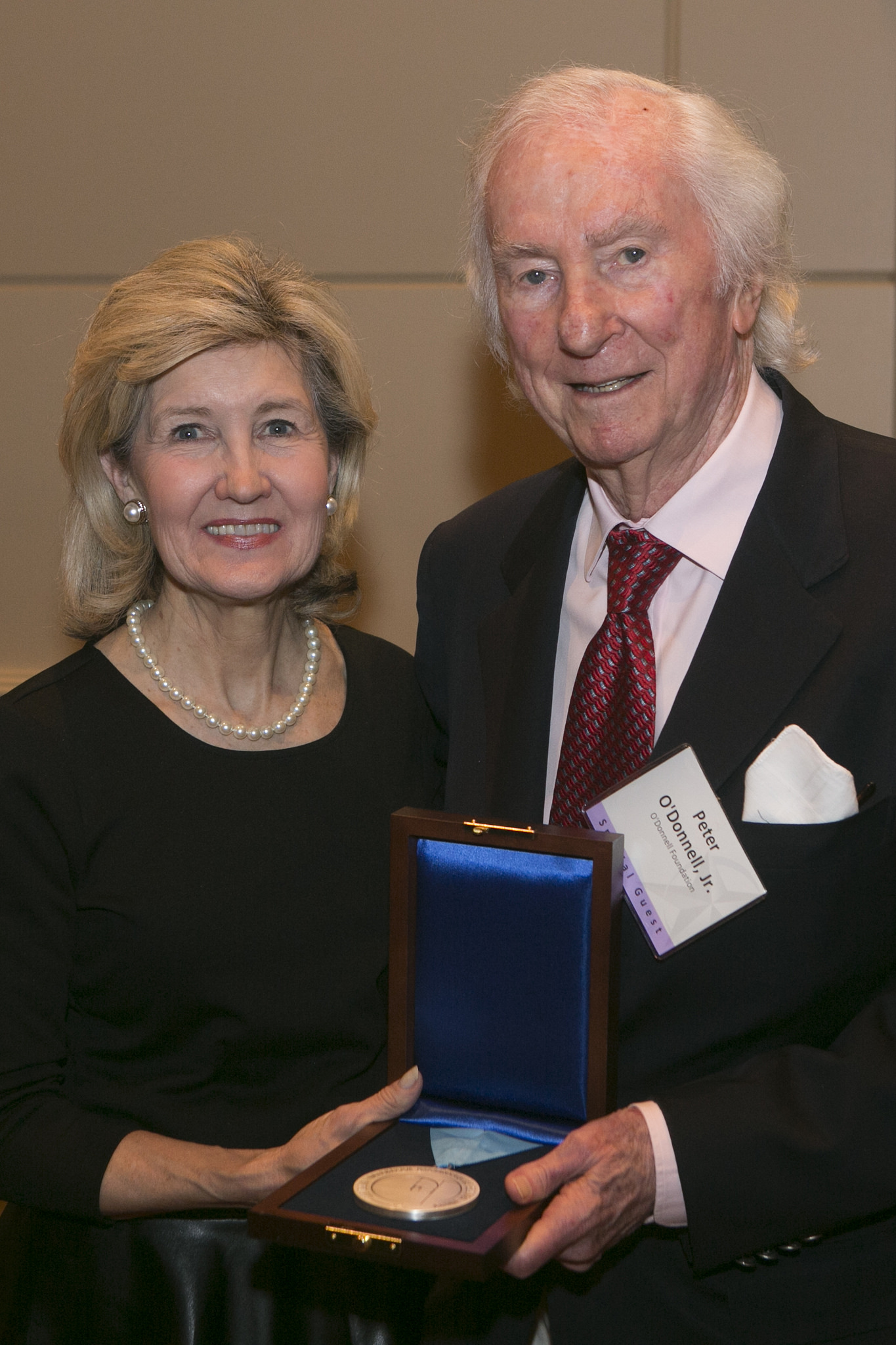
In 2004, Sen. Hutchison asked Texas Nobel Laureates Drs. Michael Brown of UT Southwestern and Richard Smalley of Rice University to think through the details of what would become TAMEST.
“We wanted to establish a vehicle for our state’s best researchers to collaborate across institutions, to share their discoveries, utilize each other’s resources and get peer-level feedback,” Sen. Hutchison said. “Our world-class research institutions and university-based innovation centers bring new technology and research together with savvy entrepreneurs, creating new businesses and, most importantly, creating jobs.”
O’Donnell and his wife, Edith, provided an endowment that would grow to generate $100,000 annually.
The Edith and Peter O’Donnell Awards are given each year to recognize rising Texas researchers responsible for cutting-edge work in medicine, engineering, biological sciences, physical sciences, and technology innovation. Since the awards began in 2006, more than $1.5 million has been awarded to more than 75 recipients, and 19 recipients have gone on to be elected to the National Academies.
TAMEST’s work has also expanded through programs such as the Hill Prizes, which were created to accelerate high-risk, high-reward research ideas in Texas. Awarded in seven categories: artificial intelligence, biological sciences, commercialization, innovation and technology, engineering, medicine, physical sciences, and public health; each Hill Prize provides $500,000 in seed funding to advance groundbreaking science and strengthen Texas’ position as a destination for world-class research.
Today, TAMEST brings together more than 360 members, eight Nobel Laureates, and 23 member institutions, drawing from Texas-based members of the National Academy of Medicine, National Academy of Engineering, National Academy of Sciences, and other honorific organizations. Its interdisciplinary model continues to foster collaboration, advance research and innovation, and serve as a recruitment tool for top research and development centers across Texas.
Southwestern Medical Foundation is a proud supporter of TAMEST, including their Annual Conference.